
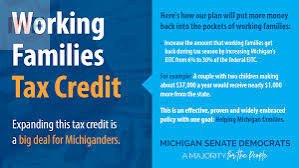
Michigan’s expanded Working Families Tax Credit continues to deliver real money to working families in 2026. Over 700,000 Michigan families have received tax credit checks averaging $550+ per family since the program expanded.
Michigan Sends $550+ Tax Credit Checks to Working Families: 2026 Guide
Starting in 2026, this benefit is automatically calculated and included in your standard state tax refund — no separate claim needed.
If you earn under approximately $48,000 (for single filers) and work in Michigan, you likely qualify for this substantial tax break.
What Is the Michigan Working Families Tax Credit?
The Michigan Working Families Tax Credit (also called Michigan’s Earned Income Tax Credit expansion) is a state-level income tax credit that supplements the federal Earned Income Tax Credit (EITC).
Calculate Your 2026 COLA Increase →How it works:
- The credit equals 15% of your federal Earned Income Tax Credit
- Automatically calculated on your Michigan state tax return
- Added to your state tax refund (or reduces taxes owed)
- Refundable credit = if it exceeds your tax liability, you get the difference back as a refund
Who Qualifies for the Michigan Working Families Tax Credit?
You qualify if you meet all of these conditions:
- Earned income: You had self-employment or wage income in 2025
- Income limit: Your adjusted gross income (AGI) is under approximately $48,110 (for 2026; adjusted annually)
- Federal EITC: You qualify for the federal Earned Income Tax Credit
- Residency: You were a Michigan resident for the entire 2025 tax year
- Filing requirement: You file a Michigan state income tax return
- Valid taxpayer ID: You have a valid Social Security Number (SSN) or Individual Taxpayer Identification Number (ITIN)
Maximum Credit Amount: How Much Can You Get?
The Michigan credit is 15% of your federal EITC, so the maximum Michigan credit depends on your federal credit:
Federal EITC Maximum (2026):
- No qualifying children: $600 federal EITC → $90 Michigan credit
- 1 qualifying child: $3,995 federal EITC → $599 Michigan credit
- 2 qualifying children: $6,558 federal EITC → $984 Michigan credit
- 3+ qualifying children: $6,935 federal EITC → $1,040 Michigan credit
Historical average: Families have been receiving an average of $550 per year (varies widely by income and children).
Step-by-Step: How to Claim the Michigan Working Families Credit
The 2026 process is much simpler than prior years. As of January 1, 2026, the Michigan credit is automatically calculated when you file your state return.
Step 1: File Your Federal 1040 First
The Michigan credit is tied to your federal EITC, so you must:
- File your 2025 federal Form 1040 (IRS return)
- Claim all qualifying children
- Report accurate income
- Calculate your federal EITC
Step 2: File Your Michigan State Return
When you file your 2025 Michigan Form MI-1040 (state return):
- If using tax software: The software automatically calculates the Michigan credit, which is included in your Michigan refund. No separate claim needed.
- If filing by hand: Michigan Department of Treasury mails updated forms to include the credit calculation.
Step 3: Choose Your Refund Method
- Direct deposit (fastest): Set up direct deposit on your return. Refund (including Michigan credit) issued within 21 days of filing.
- Paper check (slower): Refund processed and mailed. Takes 4-6 weeks after filing.
Tip: File electronically with direct deposit in January-February for fastest payment.
Timeline: When Will You Receive Your Michigan Working Families Credit?
Filing Timeline:
- File: January-April 2026
- Processing time: 1-3 weeks (e-file) or 4-6 weeks (paper)
- Payment method: Direct deposit (fastest) or paper check
Expected Receipt:
- E-file with direct deposit filed in January: Refund by mid-February 2026
- E-file filed in February: Refund by early March
- E-file filed in April: Refund by late April/May
- Paper return: May-June 2026
Is the Michigan Credit Taxable? Tax Implications
Good news: The Michigan Working Families Tax Credit is NOT taxable income on your federal or state return. It’s a tax credit (reduction of tax owed), not income. You do NOT need to report it on your next year’s return.
Frequently Asked Questions: Michigan Working Families Credit
Q: I have no children. Do I qualify for the Michigan credit?
A: Yes, you can still qualify if you are between ages 25-64, have earned income under $19,104 (2026 limit), and claim the federal EITC for workers without qualifying children. Maximum benefit without children: approximately $90 (15% of ~$600 federal EITC).
Q: Do I need to do anything special to get the 2026 credit?
A: No. Starting 2026, the credit is automatically calculated by tax software or your tax preparer. Just file your Michigan return as normal.
Q: Can I claim this credit and the child tax credit?
A: Yes. The Michigan Working Families Credit and the federal Child Tax Credit (CTC) are separate credits that can be claimed together.
Q: My income comes from self-employment. Do I still qualify?
A: Yes. Self-employment income counts as earned income for EITC and Michigan credit purposes. You must file Schedule SE.
Q: When will Michigan increase the credit percentage?
A: As of 2026, the credit is 15% of federal EITC. Future increases depend on state budget and legislation. Check the Michigan Department of Treasury for updates.
Key Takeaways: Michigan Working Families Credit Action Plan
Before Filing (January 2026):
- Verify you meet all eligibility requirements
- Gather income documents (W-2s, 1099s, pay stubs)
- Collect Social Security numbers for all household members
- Use IRS EITC Eligibility Assistant to confirm federal EITC eligibility
Important Disclaimer
This article is for informational purposes only. For specific tax advice about your situation, consult a tax professional or contact the Michigan Department of Treasury.
